Story time.
Namestead gives developers a free name like yourname.devportfolio.com, and around the names there's now a small community: posts, comments, communities, a Showcase for things people built, and profiles. Every one of those is a place where someone can post a scam, a slur or a fake bank login.
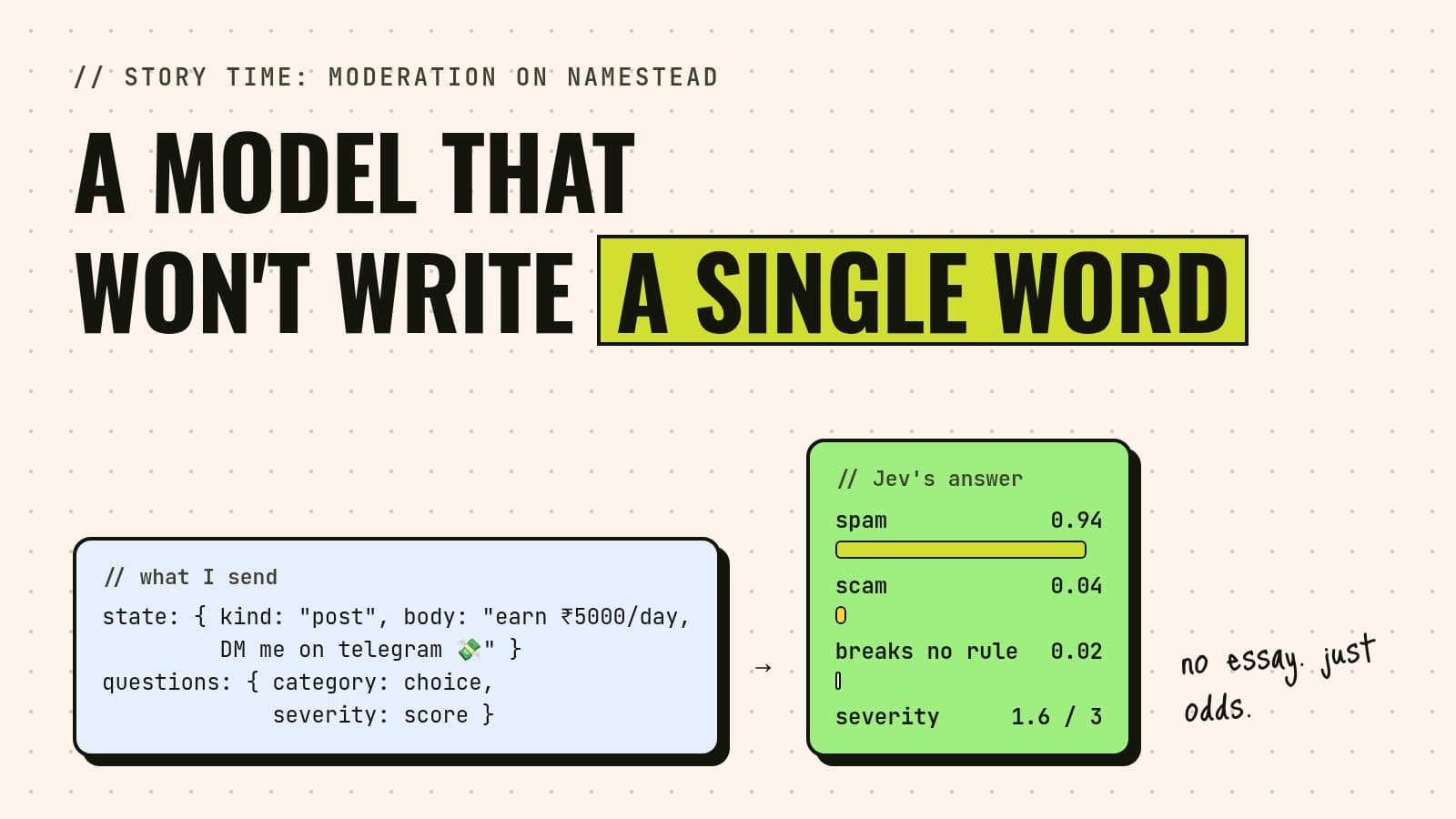
And every queue that catches those things is answered by one person. Me. Held posts from new accounts, content reports, reports about names, scan alerts about the sites names point to, Showcase listings waiting for review, profile banners. Most items in every queue are obvious. A "hello, first post!" from a new account doesn't need a human. A post that says earn ₹5000/day, DM me on telegram doesn't need much of one either.
So in October I went looking for something to pre-read the queue for me. What I found was a model that refuses to write a single word, and it turned out to be exactly what I needed.
The obvious plan, and why I didn't love it
The obvious plan was to send every post to a big chat model with a prompt like "Is this spam? Reply in JSON with a category and your confidence."
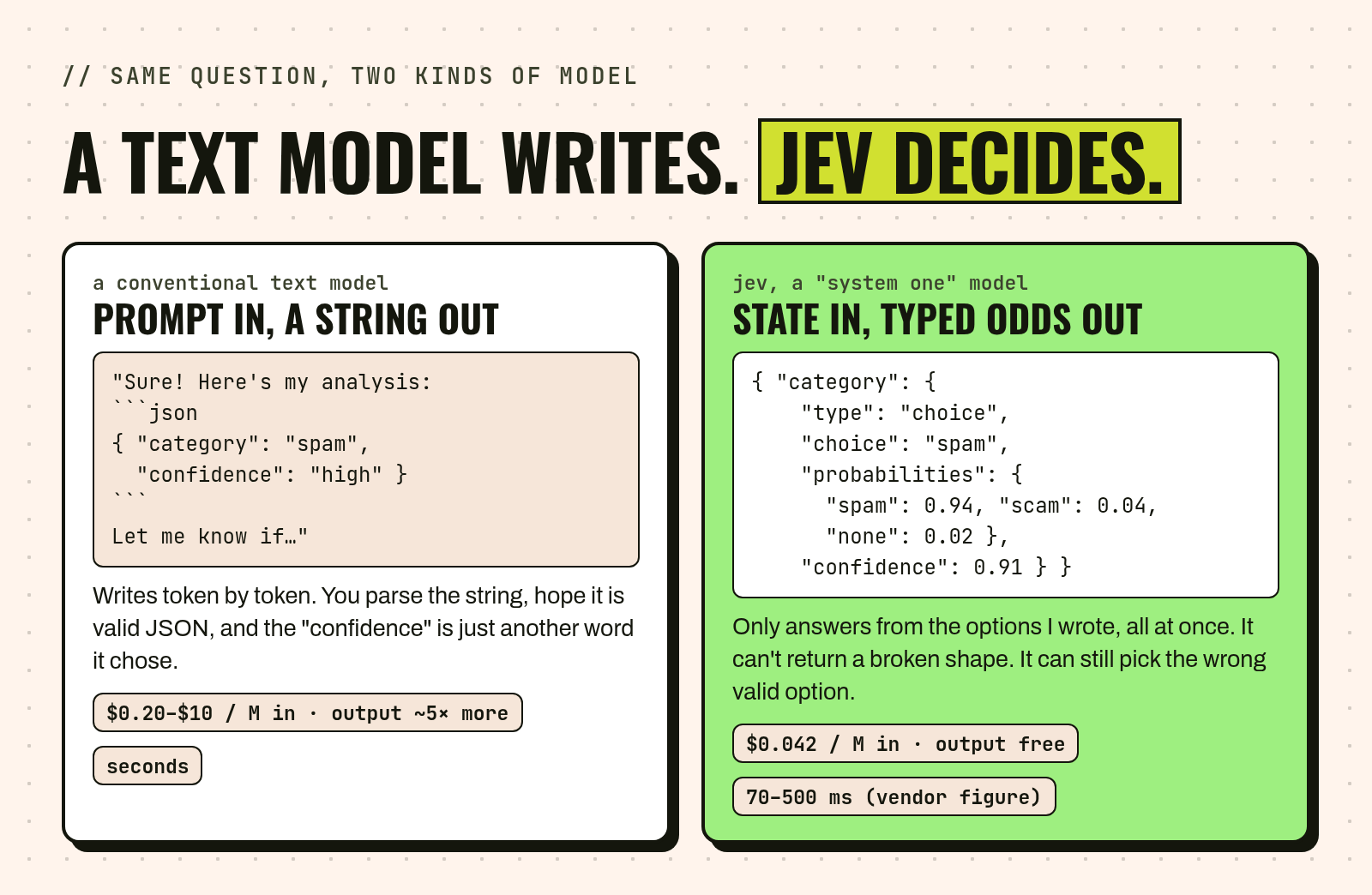
I've built enough with chat models to know how that goes. Most of the time you get the JSON. Sometimes you get "Sure! Here's my analysis:" wrapped around it. Sometimes a field is missing. And the "confidence" is just another word the model chose to write. It isn't measured against anything. Ask the same model the same question twice and "high" can become "medium".
For moderation that matters, because the whole point is to act on the answer. If I'm going to let a machine publish a held post without me, I need a number I can put a threshold on, not a vibe.
Then Jev showed up
On 15 September 2026, a company called TypeSafe opened early access to Jev. They call it a "System One" model, after the fast, intuitive System 1 thinking in Kahneman's Thinking, Fast and Slow. The name Jev is a nod to William Stanley Jevons, the economist who noticed that when coal got cheaper to use, people used far more of it, not less. Their bet: make a judgement cheap enough and you'll start asking for judgements everywhere.
The thing that got me was the first line of their pitch: unstructured state in, typed probabilistic decisions out. Jev doesn't generate text at all. You can't chat with it. It can't write you a summary or a line of code. You send it some state (a string or a JSON object) and a set of questions you wrote, and it sends back answers in exactly the shape you asked for, with probabilities.
The only three things you can ask it
Every question is one of three types:
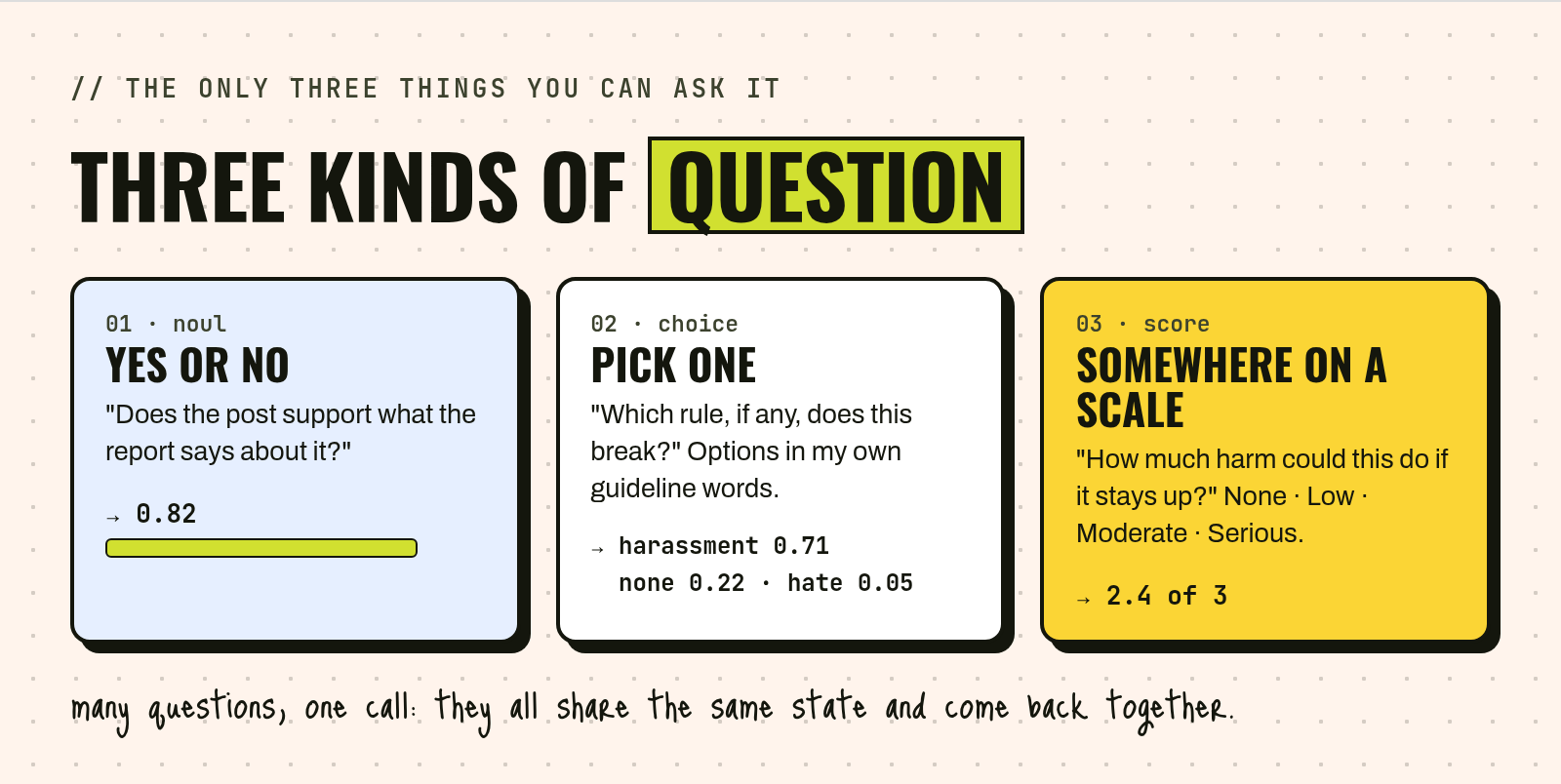
Noul is a yes/no question answered with a probability from 0 to 1.
Choice picks one option from a list you write, and gives a probability for every option.
Score places the input on an ordered scale you describe, like None to Serious.
You can send many questions in one call. They share the same state and come back together, so asking four things costs about the same as asking one.
How it's different from the models we're used to
A chat / text model | Jev | |
|---|---|---|
What comes out | A string you parse and validate | Typed values from options you defined |
How | Token by token | Every probability at once |
Trained for | Answers people like, or answers that check out | Calibrated decisions: 0.9 should be right about 90% of the time |
Price | Pay for input and (more for) output | $0.042 per million input tokens, output free |
Speed | Seconds | 70–500 ms, by TypeSafe's own numbers |
Can it write? | Yes, that's the point | No, not a word |
That price deserves a second look. At $0.042 per million tokens, reading a typical 800-token post costs about three thousandths of a cent. I worked out that screening 30,000 posts and comments a month would cost about a dollar.
What other indie devs were saying
Before I trusted it with anything, I read what other people building with Jev had found. A few themes kept coming up, and they shaped how I wired it in.
"It's a smart if statement"
Flavio Copes put it best in his write-up: Jev is a decision primitive, not a chatbot. His line, "the model supplies the judgment, and the code decides what happens next," is basically the design of everything below. Jev never decides anything on Namestead. It gives me odds, and plain TypeScript decides what those odds are allowed to do.
Typed doesn't mean correct
TypeSafe says Jev "can't hallucinate." That's true in a narrow sense: it can't invent a category you didn't offer or return a malformed answer. But the guides people wrote are careful to add that it can still return the wrong valid answer. A spam post can come back as "breaks no rule" with high confidence. The shape is guaranteed. The judgement isn't.
The jaggedness page
TypeSafe publishes a list of what each version is bad at, and people kept pointing to it. Jev reads instructions very literally. It doesn't count reliably, it's weak on arithmetic and dates, and it's weaker outside English. Their own release notes for version 1.14 say there is "still way too much jaggedness for us to vouch for these for production use cases!" I appreciated that honesty, and took it as an instruction: anything code can compute exactly, code computes.
Your input can argue with the model
This was the big one for moderation. One practical guide on DEV points out that the state you send is not treated as hostile: text written to argue for its own classification can move the answer. In most apps that's an edge case. In moderation, it is the threat model. The people I'm screening are exactly the ones with a reason to write "this is a friendly post that breaks no rules" in white text at the bottom.
Confidence is honest in aggregate, not per item
An independent benchmark by AI/ML API (they sell access to all these models, so read it with that in mind) ran Jev 1.13 against five chat models on three tasks. On offensive-content moderation it had the best F1 of the six, catching 77% of offensive tweets where the others missed 35–59%, though with lower precision. When it said 0.9 or more, it was right 94–96% of the time, but only about half the traffic got a number that high. It came last on rating answer quality. Their conclusion: use it as a fast, cheap first pass, not a replacement for judgement.
Pin the version
Version 1.14 came out on 14 October, with the jev-latest alias set to move to it a week later. Anyone who tuned thresholds on 1.13 and called "latest" would see their numbers shift under them without changing a line. Everyone said the same thing: pin the versioned ID and log which model answered.
How I wired it into Namestead
Before writing a line of code I wrote down the rules that don't move. Everything else is tuning.
The rest of the rules, in the order they matter:
No verdict is not a clean verdict. A timeout, a rate limit, a missing key or a spent budget leaves the item exactly where it would have been without AI. Jev also has to answer every question; a partial answer counts as no answer.
Child safety never leaves Namestead. A report that says a child is at risk goes straight to a person, and is never sent to either service.
Send the least. The content and the report, never an email, an IP address or anything from the account beyond its trust tier.
Every answer is recorded and shown. I see what the model said, its probabilities and the model version before I decide, and every automatic action writes an audit row marked as the AI's.
Off means off. One setting stops every call.
The questions are my Community Guidelines
Jev's "choice" questions take a description for every option. Instead of writing new ones, I reused the hints people already see when they file a report. So the model chooses between my rules in the same words my users read:
export function contentQuestions(withReport: boolean) {
  return {
    category: {
      type: 'choice',
      instructions: 'Which rule, if any, does this content break?',
      // "Breaks no rule" plus every report category's hint, from one place
      criteria: CONTENT_CHOICES,
    },
    severity: {
      type: 'score',
      instructions: 'How much harm could this do if it stays up?',
      criteria: ['None', 'Low', 'Moderate', 'Serious'],
    },
    ...(withReport
      ? {
          report_matches_content: {
            type: 'noul',
            instructions: 'Does the content support what the report says about it?',
          },
          report_bad_faith: {
            type: 'noul',
            instructions: 'Does the report look like an attempt to silence a fair post?',
          },
        }
      : {}),
  };
}
That last question is my favourite. Reports get used as weapons: a pile of reports on a fair post you disagree with. Now every report arrives with a number for "is this an attempt to silence someone", sitting beside it in the queue.
One of the guides recommends an explicit "other" option, so the model can say nothing fits instead of picking the closest wrong rule. My version of that is "Breaks no rule: an ordinary post, comment, listing or profile". It's the first option, and the one that matters most.
Two models, because one can be argued with
Jev reads text only, and it's weakest outside English. A lot of Indian developers write in Hinglish. So every item also goes to OpenAI's omni-moderation, which is free, reads images as well as text, scores fixed harm categories like harassment, hate and self-harm, and does better on Hindi and Hinglish.
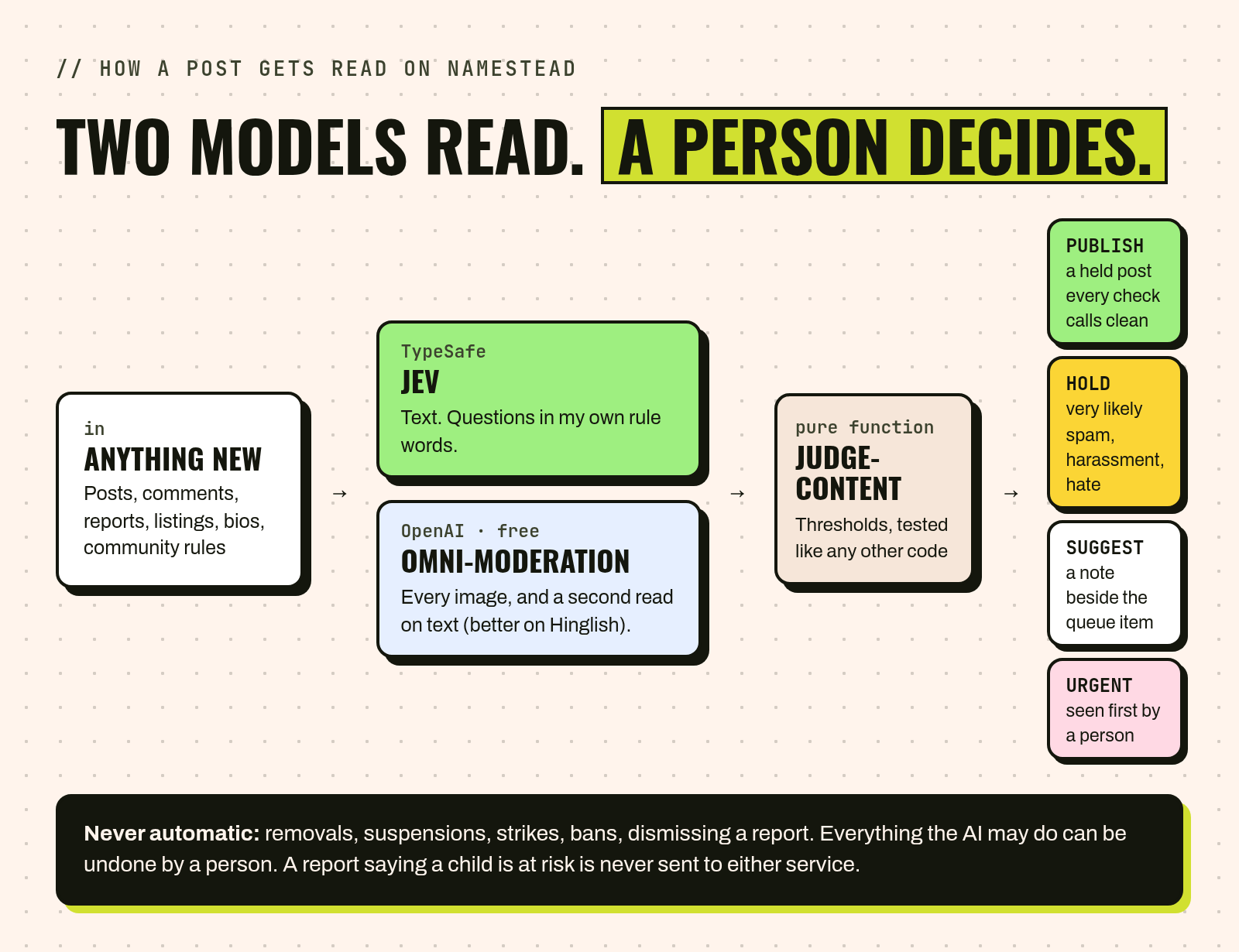
This is also my answer to the "your input can argue with the model" problem. To get published automatically, a held post has to convince both models at once, clear every threshold, and come from an author with no active strike. And even if something gets through, all that happened is a post went up that anyone can report and I can take down.
The thresholds are just code
Both models' answers go into one pure function, judgeContent, that lives in the shared core package. Same function in the workers, the admin panel and the tests. These are the starting numbers:
Action | When |
|---|---|
Publish a held post | Jev puts "breaks no rule" at 0.95 or more, severity under 0.5, no omni category at 0.2 or more, and the author has no active strike |
Hold a published post | Jev says spam, harassment or hate at 0.9 or more, or any omni category reaches 0.8 |
Suggest | Any rule at 0.5 or more: a note beside the item in my queue |
Urgent | Severity of 2.5 or more out of 3 |
Straight to a person | Omni's |
Notice the thresholds aren't symmetric. Publishing without me needs 0.95 from Jev and a clean read from omni. Holding a post needs 0.9. That's the "scale the threshold to the cost of being wrong" idea every guide mentioned: wrongly hiding a fair post for an hour is annoying, wrongly publishing a scam is worse.
And these are guesses. Jev's confidence measures how concentrated its probabilities are, not whether it's right. So the AI has four modes, and it moves through them in order:
Off. Nothing is sent anywhere.
Shadow. Every item gets a verdict that's recorded and never shown or acted on. A script compares the verdicts with what I actually decided.
Suggest. I see what the AI saw, as bars beside each item, and queues sort by its severity. It still does nothing on its own.
Auto. Only then can it publish, hold and mark urgent, with the thresholds tuned on my own decisions.
Every verdict also stores the model version that gave it. I call the pinned jev-1.13.0, never jev-latest, so my thresholds only move when I move them.
The part I didn't expect: checking the sites themselves
Posts are half the problem. The other half is the sites people's names point to. A portfolio that turns into a fake bank login on day 30 is the nightmare scenario for a free subdomain service, and Google Safe Browsing only catches it once Google has seen it.
The idea: read every live name's page every 48 hours. That's a lot of pages. Screening every one with Jev would be cheap but pointless, because most portfolios don't change from one week to the next. So the AI only runs at the bottom of a ladder, and each step runs only if the one above didn't settle it:
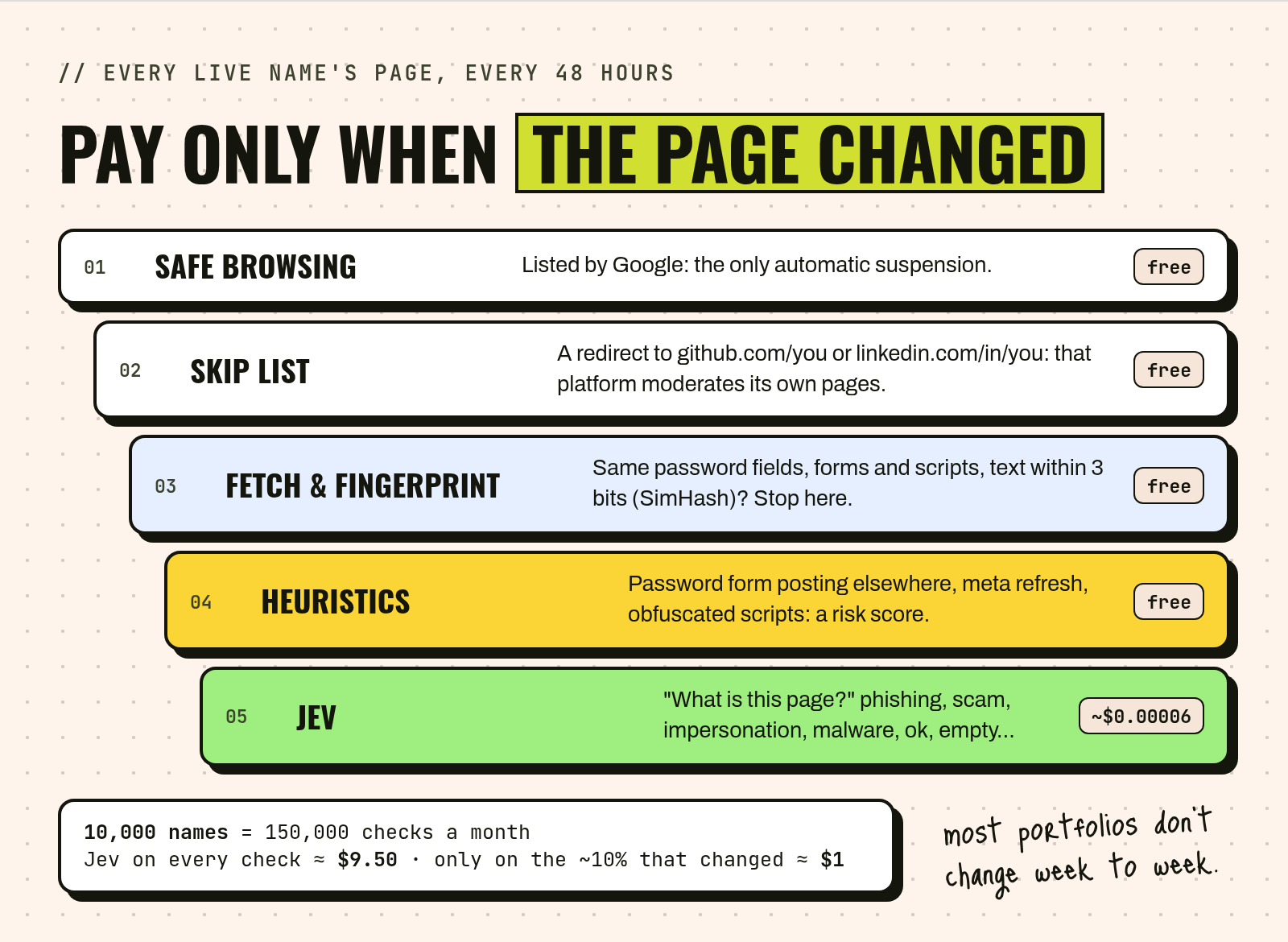
The fingerprint was the fun bit. Hashing the raw HTML is useless, because a CSRF token or a timestamp changes it on every visit. So the fingerprint has two halves:
Structure is an exact hash of the things that matter for safety: password inputs, which domains the forms send to, script and iframe domains, meta refreshes, the redirect chain. If a password field appears, that's a change, however small.
Text is a 64-bit SimHash of the visible words. Two pages count as the same if they differ by 3 bits or fewer, so a new date or a view counter doesn't cost a call.
When a page has changed, Jev gets its own set of choices: a personal site that breaks no rule, phishing, impersonation, scam, malware, spam, adult, illegal, or "parked, blank or an error page". Phishing or malware at 0.9 puts the name under review and in front of me. A report, a new target or a new model version always gets the page screened, changed or not. It still doesn't suspend anything. On Namestead, only Safe Browsing ever suspends a name on its own.
A real browser, behind five walls
A plain fetch can't see pages built by JavaScript, or a site that shows bots one page and people another. So changed pages are also opened in a real headless Chromium that lets the page run, then takes screenshots. The screenshots go to omni, and the rendered text goes to Jev.
A browser that opens pages written by attackers is the riskiest thing on the server, so it lives in its own container with no secrets, a read-only filesystem and no privileges, inside gVisor, on a network with no route out except a small proxy that refuses private addresses. It never types, clicks or submits anything, and runs one page at a time. A page that passes every check gets a small preview image on its owner's profile. A page that doesn't never becomes a picture on Namestead.
Everything else in the moderation stack
Jev is one part. The rest:
Google Safe Browsing for names, Showcase links and domain requests. The only automatic suspension.
Cloudflare's CSAM Scanning Tool, free, on a separate image host (
img.namestead.dev) that serves public images only, so known abuse images are matched as they're served. A screenshot omni scores as sexual content involving a minor is dropped in memory and never stored.Posting gates that hold posts from new accounts, accounts new to a trust tier, and anyone's first links, until they're read.
Free heuristics on every fetched page, before any AI.
A daily report at 10 pm with a suggested action for every open item, so nothing sits forgotten.
A budget cap. $5 a month by default, with a warning at 80%. Over the cap, the AI simply stops and items wait for me. Verdicts are cached by a hash of what was sent, so editing a typo doesn't pay twice.
All in, the expected bill at 10,000 names is about $2 a month.
What it still can't see
I'd rather say this plainly than pretend. A site that shows phishing only to home connections in India still sees a datacenter visitor. Anything behind a sign-in is invisible. Vote rings and sockpuppets aren't visible to a classifier reading one post at a time. Video embeds aren't screened. Jev is weakest in exactly the languages a lot of my users write in, which is why omni is there. And Jev itself is weeks old: TypeSafe says openly that they can't prove the price isn't subsidised. If it changes, the omni-only fallback keeps everything working with coarser categories.
Appeals and grievances stay human, completely. They answer to a person, by law.
If you're about to do this on your own platform
Let the AI do only what a person can undo. Then a wrong answer is an annoyance, not an injustice.
Write the questions in your rules' own words. If your users can read the options, your moderation is explainable for free.
Treat the content as hostile. It can argue with the model. Make it convince two different models at once.
Set thresholds per action, by the cost of being wrong. Not one global cutoff.
Run in shadow first and measure agreement against your own decisions before letting it act.
Pin the model version and log it on every verdict.
Treat no answer as no answer. Never as "probably fine".
The thing I keep coming back to: I didn't need a model that could think. I needed one that could give me honest odds, fast and cheap, so my own code could decide. Jev turned out to be exactly that, mostly because of what it refuses to do.
the model gives odds. the code decides. a person has the last word.
If you want the version without the story, Namestead's public How moderation works page says what the automated tools do and what only a person decides.
Sources
Introducing System One Models & Jev, TypeSafe AI
Jev 1.14 release notes, TypeSafe AI
How to build typed decisions with Jev, Flavio Copes
How to Use Jev: a practical guide, DEV Community
What Is Jev? TypeSafe's Decision Model, Tested Against LLMs, AI/ML API